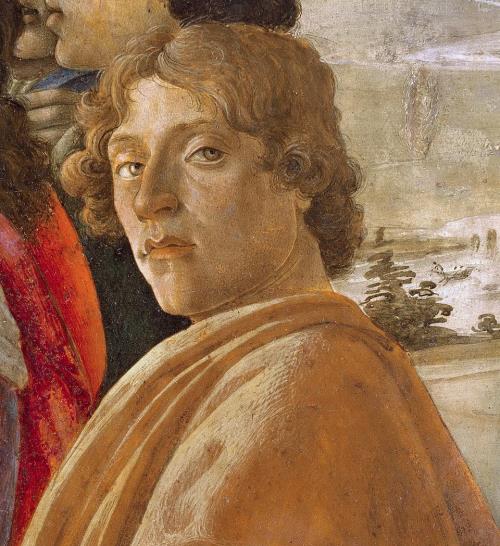
1445-1510
Место рождения: Florence
Род занятий: Painter
Место жительства: Florence
Стили и направления: Renaissance
Подпись: S.B.
Страница в интернете: https://sandrobotticelli.net/
Collection used to demonstrate features of CatalogTools software
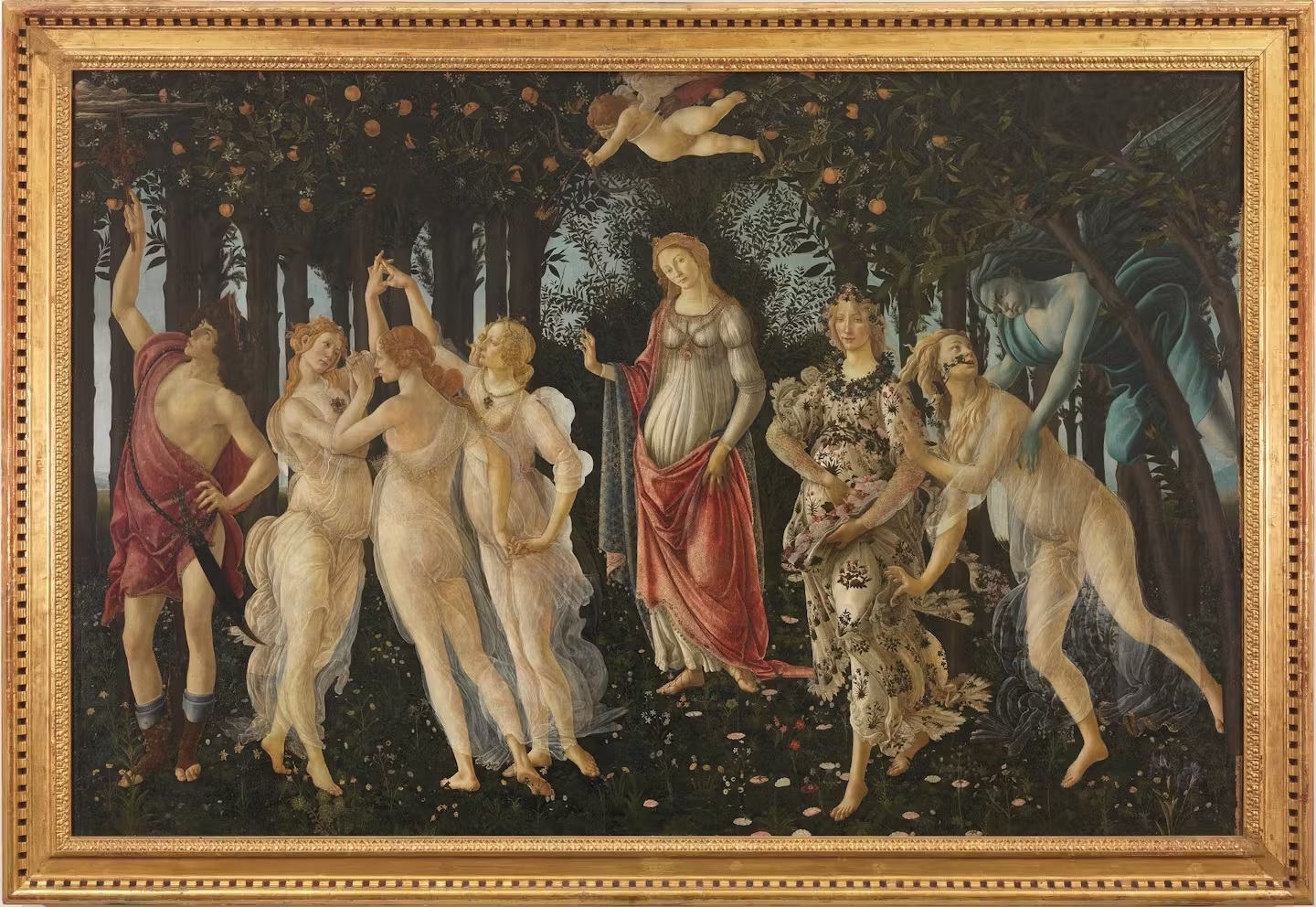
La Primavera, 1480-1485. Tempera on wood, 203 x 314 cm
https://www.uffizi.it/en/artworks/botticelli-spring
Тип: Картина
Жанр: Религиозный
Стиль или направление: Возрождение
Местонахождение: Uffizi Gallery (43,77° с.ш.; 11,26° в.д.)
От составителя: This painting, usually known as the Primavera (or Spring) shows nine figures from classic mythology advancing over a flowery lawn in a grove of orange and laurel trees. In the foreground, to the right, Zephyrus embraces a nymph named Chloris before taking her; she is then portrayed after her transformation into Flora, the spring goddess. The centre of the painting is dominated by the goddess of love and beauty, Venus, chastely dressed and set slightly back from the others, and by a blindfolded Cupid, firing his arrow of love.
On the left, the three Graces, minor goddesses with virtues like those of Venus, are shown dancing in a circle. The composition is closed by Mercury, messenger of the Gods, recognisable from his helmet and winged sandals, as he touches a cloud with his staff.
Although the complex meaning of the composition remains a mystery, the painting is a celebration of love, peace, and prosperity. The dark colour of the vegetation is in part due to the ageing process of the original pigment, but is lightened by the abundance of fruits and flowers. At least 138 species of different plants have been identified, all accurately portrayed by Botticelli, perhaps using herbaria. The attention to detail confirms the artist’s commitment to this piece, which is also evident in the sheer skill with which the paint has been applied.
It is painted on a poplar wood backing and towards the end of the 15th century, it was to be found in the house in Via Larga (modern-day Via Cavour) that belonged to the heirs of Lorenzo di Pierfrancesco de’ Medici, cousin of Lorenzo the Magnificent. It was hung above a lettuccio, a kind of chest with back that was often among the furniture items in noble renaissance homes. It was later moved to the Villa di Castello, where Giorgio Vasari (1550) describes it together with the Birth of Venus.
Предыдущие местонахождения: Before 1815: Villa di Castello, Tuscany; 1815-1919: Galleria dell'Accademia, Florence
История:Описание
La Primavera, large tempera painting on a poplar wood panel by Sandro Botticelli. It is believed to have been executed about 1477 to 1482. The mythological figures in the painting are an allegory of spring and of the kindling of love.
After training as a goldsmith, Botticelli was apprenticed to Fra Filippo Lippi. Lippi had developed a style of portraying expressive interactions between figures and of employing highly decorative detailing typical of the late Gothic period. Botticelli was also influenced by Antonio Pollaiuolo, whose muscular modeling announced a new approach to figurative work accounting for human anatomy and proportion. Botticelli painted on many scales, and his delicate evocations of landscape and figuration ensure his place as one of the most beloved painters of all time. [Steven Pulimood. Encyclopædia Britannica Online]
Источник: https://www.britannica.com/topic/La-Primavera-Botticelli
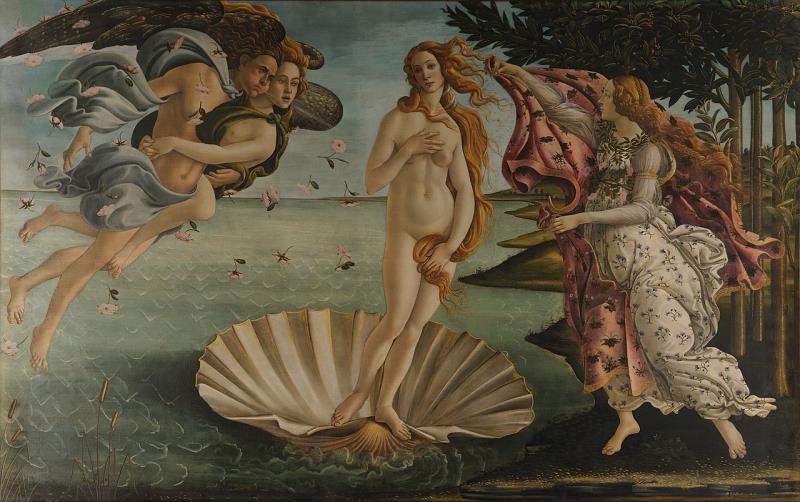
(Birth of Venus), 1485. Tempera on canvas, 172.5 x 278.5 cm
https://www.uffizi.it/en/artworks/birth-of-venus
Тип: Картина
Жанр: Религиозный
Стиль или направление: Возрождение
Местонахождение: Galleria degli Uffizi (Florence)
Known as the Birth of Venus, the composition actually shows the goddess of love and beauty arriving on land, on the island of Cyprus, born of the sea spray and blown there by the winds, Zephyr and, perhaps, Aura. The goddess is standing on a giant scallop shell, as pure and as perfect as a pearl. She is met by a young woman, who is sometimes identified as one of the Graces or as the Hora of spring, and who holds out a cloak covered in flowers. Even the roses, blown in by the wind are a reminder of spring. The subject of the painting, which celebrates Venus as symbol of love and beauty, was perhaps suggested by the poet Agnolo Poliziano.
It is highly probable that the work was commissioned by a member of the Medici family, although there is nothing written about the painting before 1550, when Giorgio Vasari describes it in the Medici’s Villa of Castello, owned by the cadet branch of the Medici family since the mid-15th century. This hypothesis would seem to be born out by the orange trees in the painting, which are considered an emblem of the Medici dynasty, on account of the assonance between the family name and the name of the orange tree, which at the time was ‘mala medica’.
Unlike the Allegory of Spring, which is painted on wood, the Birth of Venus was painted on canvas, a support that was widely used throughout the 15th century for decorative works destined to noble houses.
Botticelli takes his inspiration from classical statues for Venus’ modest pose, as she covers her nakedness with long, blond hair, which has reflections of light from the fact that it has been gilded; even the Winds, the pair flying in one another’s embrace, is based on an ancient work, a gem from the Hellenistic period, owned by Lorenzo the Magnificent. [Text by: Daniela Parenti]
Изображено: Venus, shell

Ritratto di dama, 1476—1480. Tempera on canvas, 47.5 x 35 cm
https://ru.wikipedia.org/wiki/Портрет_молодой_женщины_(картина_Боттичелли,_1476—1480)
Тип: Картина
Жанр: Портрет
Стиль или направление: Возрождение
Местонахождение: Berliner Gemäldegalerie
Alessandro di Mariano di Vanni Filipepi, better known as Sandro Botticelli (March 1, 1445 - May 17, 1510) was an Italian painter of the Florentine school during the Early Renaissance (Quattrocento). Less than a hundred years later, this movement, under the patronage of Lorenzo de' Medici, was characterized by Giorgio Vasari as a "golden age", a thought, suitably enough, he expressed at the head of his Vita of Botticelli.
His posthumous reputation suffered until the late 19th century; since then his work has been seen to represent the linear grace of Early Renaissance painting, and The Birth of Venus and Primavera rank now among the most familiar masterpieces of Florentine art.
Составитель: SmallSoft